
The Truth About Windshield Sunshades
The Truth About Windshield Sunshades
Why Most Fail — and What Actually Works

For decades, windshield sunshades have been sold as one of the simplest accessories in the automotive world. Cheap. Lightweight. Easy. Something you grab at a gas station, fold onto your dashboard, and forget about.
And yet, step into almost any car that’s been parked under the sun for a few years, and the evidence tells a different story: cracked dashboards, faded interiors, overheated steering wheels, glitching infotainment screens.
If sunshades are so common, why do they fail so often?
The answer isn’t price alone. It’s not even materials—at least not by themselves. The real problem is that most windshield sunshades are designed to look effective, not to perform effectively.
This article breaks down the windshield sunshade market from the inside out: the real types, the hidden failure points, the myths, the materials that matter, and why fitment—not reflectivity—is the most ignored factor of all.
Why Windshield Sunshades Exist (And What They’re Actually Fighting)

Most drivers think sunshades are about comfort. Less heat. A steering wheel you can touch. Seats that don’t burn your legs.
But comfort is only the surface layer.
What sunshades are really fighting is a combination of:
-
Ultraviolet radiation (UV) — responsible for fading, cracking, material breakdown
-
Infrared radiation (IR) — responsible for heat buildup and thermal soak
-
Greenhouse effect — heat enters through the windshield but struggles to escape
Modern vehicles are especially vulnerable. Large windshields, steep rake angles, expansive dashboards, and massive screens all amplify the problem. EVs make it worse, not better—bigger glass areas, fewer engine-bay heat buffers, more sensitive electronics.
A sunshade that only looks reflective but allows heat and light leakage is barely slowing the damage.
The Main Types of Windshield Sunshades (What’s Actually on the Market)

On the surface, the market looks crowded. In reality, most products fall into a handful of repeating designs.
1. Accordion / Folding Sunshades
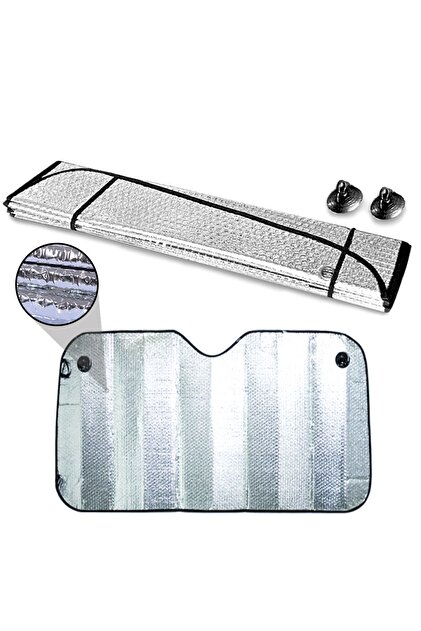
Rigid fold designs, often using cardboard or thin plastic cores with reflective surfaces.
Pros
-
Low cost
-
Easy to mass-produce
Cons
-
Crease points weaken quickly
-
Poor edge sealing
-
Structural failure under prolonged heat
-
Flat construction incompatible with curved windshields
-
Gaps around A-pillars and upper corners due to generic sizing
-
Light leakage caused by approximate, non-vehicle-specific fitment
- Suction cups lose adhesion under heat, leaving the shade sagging or detached, creating new light gaps and encouraging repeated re-positioning that accelerates material fatigue and fitment failure.

2. Umbrella-Style Sunshades
Central shaft designs that open like a compact umbrella inside the vehicle.
Pros
-
Quick deployment
-
Compact storage
Cons (and these matter)
-
Dashboard contact pressure leading to material stretching and tearing
-
Scratching and abrasion on infotainment screens during deployment
-
Stress on center console and trim pieces
-
Inconsistent windshield coverage due to rigid shaft geometry
-
Central-shaft design prevents proper edge sealing on most windshields
-
Poor compatibility with steeply raked or wide windshields
-
Fitment dictated by the mechanism, not the vehicle
In real-world use, umbrella sunshades introduce a new problem: they apply force where vehicles were never designed to receive it. Dashboards flex. Touchscreens scratch. Trim pieces loosen.
Convenient? Yes.
Harmless? No.
3. Foam-Core Accordeon Sunshades
Multi-layer constructions using insulating foam sandwiched between reflective layers.
Pros
-
Better thermal insulation
-
More stable shape
Cons
-
Bulkier storage
-
Wide quality variation
-
Limited ability to conform to complex windshield curvature
-
Gaps around camera housings and mirror mounts
-
Edge lift over time as foam loses shape memory
4. Lightweight Reflective Polyester Sunshades
Lightweight polyester constructions with metallic or aluminum coatings.
Pros
-
Lightweight
-
Cost-efficient
Cons
-
Many prioritize appearance over performance
-
Low-density weaves degrade quickly
-
Coatings often reflect light, not heat
-
Generic templates cause poor coverage at top corners
-
Excess material bunching or slippage due to imprecise fitment
-
Inconsistent sealing across different vehicle models
5. Magnelex Custom-Fit Windshield Sunshades

Designed specifically for individual vehicle models and exact windshield geometries—down to curvature, mirror mounts, and camera housings.
Unlike generic “custom-style” claims, Magnelex approaches fitment as an engineering problem, not a marketing phrase.
At the core of the design is a dual-layer construction using 2 × 240T high-density polyester—a material specification that simply doesn’t exist in most of the mass-market sunshade category.
This isn’t about adding bulk. It’s about controlling heat, structure, and longevity in real-world conditions.

What sets this construction apart:
-
Double-layer 240T polyester for superior heat reflection and structural stability
-
Significantly higher material density than common single-layer designs
-
Reduced deformation under prolonged heat exposure
-
Improved edge sealing against light and heat leakage
Most sunshades on the market rely on thinner, lower-density fabrics that look reflective but lose effectiveness as temperatures rise. The result is a product that works briefly, then quietly degrades.
Magnelex’s approach focuses on maintaining performance over time, not just out of the box.
Pros
-
Maximum windshield coverage through true vehicle-specific fitment
-
Minimal light leakage due to precise edge geometry
-
Superior long-term performance thanks to high-density, double-layer material
Cons
-
Higher upfront cost compared to universal alternatives
-
Requires extensive, accurate fitment data for each vehicle
This category is where most marketing claims collapse under real heat.
It’s also where material science and fitment accuracy finally start to matter.
Why Most Windshield Sunshades Fail (Even the “Good” Ones)
The failure of a sunshade rarely happens on day one. It happens quietly, over months.
❌ Poor Fitment
Light entering around the edges defeats the purpose entirely. Heat doesn’t need much space—millimeters are enough.
❌ False Reflectivity
Shiny does not equal effective. Many coatings reflect visible light but absorb infrared heat.
❌ Material Collapse
Heat causes folding points, wires, or foam cores to weaken. Once structure is lost, coverage follows.
❌ Heat Trapping
Some designs reflect sunlight inward but trap heat between the shade and glass, raising interior temperatures instead of lowering them.
❌ One-Size-Fits-All Thinking
Windshields are not rectangles. They are compound curves with camera housings, mirror mounts, and rake angles that vary by model year.
Most sunshades fail not because they’re cheap—but because they’re imprecise.
Materials That Actually Matter (And the Ones That Don’t)
Material specs are where marketing loves to hide.
Polyester Density
Low-density polyester deforms quickly and loses reflectivity. Higher-density weaves maintain structure and performance over time.
Reflective Layer Type
-
Aluminum film: highly reflective, but prone to cracking
-
Metallized coating: more durable, better longevity
Core Thickness
Foam and multi-layer constructions insulate better but must balance rigidity with storage practicality.
Stitching & Edge Sealing
Edges matter. This is where light leaks begin. Weak stitching = early failure.
Backing Surface
A soft backing reduces slippage and improves windshield contact—often overlooked, but critical.
None of these features look exciting on a product photo. All of them matter in real use.
Fitment: The Most Ignored Factor in the Entire Category
Windshields differ by:
-
Curvature
-
Width at top vs bottom
-
Mirror mount position
-
ADAS camera housings
-
Model-year revisions
A sunshade that “almost fits” will always fail.
Custom fitment isn’t a luxury—it’s the only way to:
-
Seal the windshield
-
Maintain position
-
Prevent heat leakage
Yet most manufacturers still design for categories, not vehicles.
Real-World Conditions Sunshades Are Rarely Tested For

Laboratory tests don’t account for:
-
Angled parking
-
Prolonged heat soak
-
Repeated folding cycles
-
High-humidity + heat environments
Arizona, Texas, Florida—these conditions expose weaknesses fast. A sunshade that survives here survives anywhere.
Marketing Myths vs Reality
-
“Blocks 99% UV” (measured how?)
-
Star ratings ≠ long-term durability
-
Photos taken in studios, not sunlight
Performance isn’t aesthetic. It’s functional.
What a High-Quality Windshield Sunshade Should Actually Do
A real sunshade should:
-
Seal the glass
-
Reflect heat, not trap it
-
Maintain structure over years
-
Store without permanent deformation
-
Match the vehicle—not the segment
Anything less is temporary relief, not protection.
The Future of Windshield Sunshades
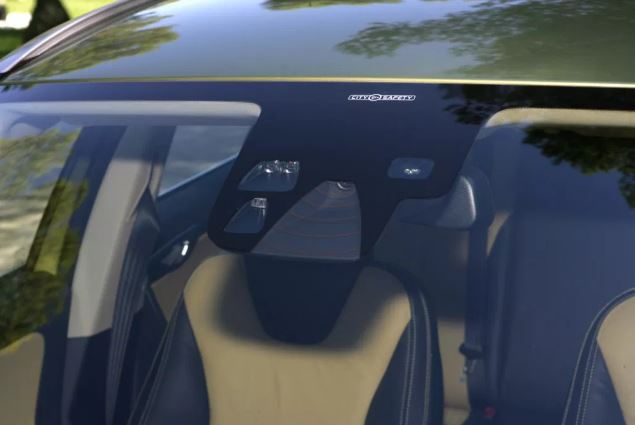
As vehicles evolve, sunshades must evolve with them. Bigger glass, more electronics, higher thermal sensitivity.
The era of universal shortcuts is ending.
Precision is no longer optional.
Final Thought
Windshield sunshades aren’t accessories anymore. They’re protective equipment. And like all protective equipment, design accuracy matters more than marketing promises.
Most fail because they were never designed to succeed.

